This Print On Demand book will be sent within 1 to 2 weeks (metropolitan France) and in a separate package if you order another paperback book.
Cet ouvrage en impression à la demande sera envoyé sous 1 à 2 semaines environ (France métropolitaine) et dans un colis séparé en cas de commande avec un autre livre papier.
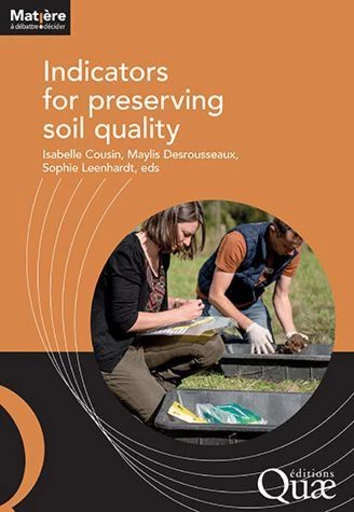
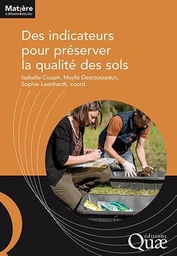
Soils play a vital role in ecosystems, food security and health. To support public policies aimed at preserving soil functions and conservation, a multidisciplinary group of 19 experts from various public research organisations, coordinated by INRAE, analysed the scientific literature on soil quality and health. They have compiled the main available resources and key considerations for conducting assessments based on the ecological functions performed by soils. Around fifty physical, chemical and biological indicators are linked to an interpretation framework that specifies measurement or calculation methods, as well as reference values for interpretation.
The selection of indicators depends on the assessment’s objectives, such as drafting urban planning documents or zoning agricultural plots for land consolidation. To adequately choose these indicators, select the interpretation framework and determine the monitoring grid (spatial and temporal), and whether to aggregate certain indicators, the assessment’s goals must be carefully considered.
This approach fosters dialogue among stakeholders from diverse social and political backgrounds, enabling them to collectively reflect on the nature of soils and the future of land use.
This book is intended for non-experts with a solid understanding of the subject, including decision-makers, professionals, and representatives of non-profit organisations and public services responsible for environmental and urban planning policies. More broadly, it is aimed at anyone interested in the public debate on soil quality and health.
Ce titre est également disponible en français sur notre site : / This book is also available in French on our website :
Des indicateurs pour préserver la qualité des sols