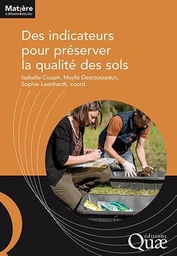
by Isabelle Cousin (editorial coordination), Maylis Desrousseaux (editorial coordination), Sophie Leenhardt (editorial coordination)
august 2026
Open Access
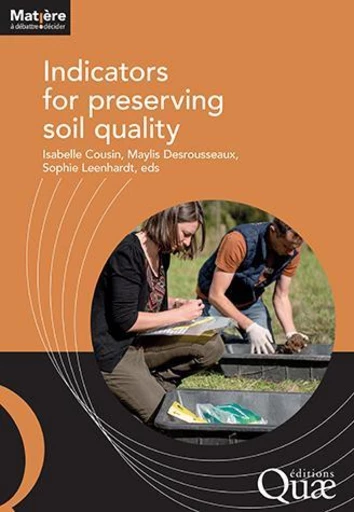
Indicators for preserving soil quality - eBook [PDF]
This book is available in paper version on our bookseller site.

Summary

Soils play an essential role in ecosystems, food security and health. In order to inform public policies concerning their proper functioning and preservation, a group of 19 experts from a variety of disciplines and public research organizations, coordinated by INRAE, analysed the scientific literature on soil quality and health. They gathered the main available resources and identified the key considerations for conducting an assessment based on the ecological functions performed by soils. Around 50 physical, chemical or biological indicators are thus associated with an interpretative framework that specifies the method of measurement or calculation and the reference values to which the result should be compared. 

The choice of indicators depends on the objectives of the assessment (development of an urban planning document, zoning of agricultural plots for land consolidation, etc.). The indicators need to be explained in order to select them, choose the interpretative framework and monitoring grid (spatial and temporal), and decide whether to aggregate some of them. 

This assessment promotes dialogue between users from different social and political backgrounds, encouraging them to reflect together on what soils are and what they are expected to be. 

This book is intended for non-experts with some knowledge on the subject: decision-makers, professional or associative actors, public services in charge of environmental and urban planning policies, etc. More broadly, it is aimed at anyone interested in the public debate on soil quality and health.

Table of contents

Foreword

1. Basis of the study

Context and handling of the study commissioning
Expert group involved
Literature analysed
Reading guide and terminology used in this condensed report

2. Implementation frameworks for soil quality assessment

Actors and mechanisms involved in soil quality assessment
Diversity of perceptions of soils and their qualities
Co-production of information on soil quality

3. Governance frameworks and soil quality

Private property and public intervention
Measures and economic values of soil quality
Criteria used in the field of law
Regulating soil de-artificialisation and ecological restoration
Territoriality of public intervention on soil quality

4. The dimensions of soil quality and health

and the choice of functions
Historical developments in terminology and concepts
A not-yet-stabilised distinction between soil quality and soil health
From soil quality to its ecological functions
Approaches to assess soil multifunctionality
Limitations of a function-based approach

5. Assessment process

Purpose of the assessment
Choice of the indicandum and of the relevant indicators
Measuring parameter and indicator values
Reference framework and interpretation framework
Scoring or normalising indicators
Multi-criteria aggregation forming a soil quality index
Monitoring soil quality over time and space

6. Generic list of soil function indicators and assessment trial in a given area

Main categories of indicators
Selected generic indicators
Operationality of indicators
Assessing soil quality in France

7. Lessons learned and avenues for research

Summary of key lessons
Areas for research
Appendices

Bibliographic sources cited

Acronyms and abbreviations

Working group

Publications in the same collection

On the same subject

Features

Language(s): English

Publisher: Éditions Quae

Published: 21 august 2026

EAN13 eBook [PDF]: 9782759243396

DOI eBook [PDF] : 10.35690/978-2-7592-4339-6

Pages count eBook [PDF]: 180

Interior: Colour

Reference eBook [PDF]: 03082NUM

Size: 10.3 MB (PDF)

--:-- / --:--