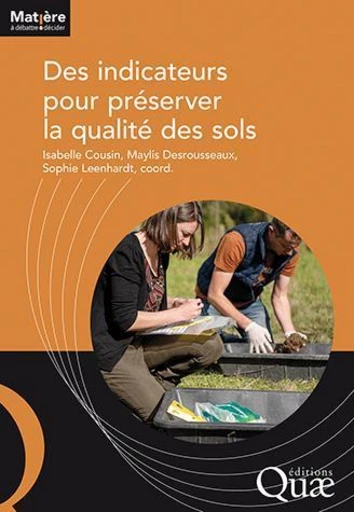
Les sols jouent un rôle essentiel pour les écosystèmes, notre sécurité alimentaire et notre santé. Pour accompagner les politiques publiques soucieuses de leur bon fonctionnement et de leur préservation, un collectif de 19 experts issus d’une diversité de disciplines et d’organismes de recherche publics, sous la coordination d’INRAE, ont analysé la littérature scientifique traitant de la qualité et de la santé des sols. Ils ont rassemblé les principales ressources disponibles et points de vigilance à considérer pour conduire une évaluation basée sur les fonctions écologiques qu’assurent les sols. Une cinquantaine d’indicateurs, physiques, chimiques ou biologiques, sont ainsi associés à un référentiel d’interprétation précisant la méthode de mesure ou de calcul, et les valeurs de référence auxquelles le résultat doit être comparé.
Le choix des indicateurs dépend des objectifs de l’évaluation (élaboration d’un document d’urbanisme, zonage de parcelles agricoles en vue d’une opération de remembrement…). Il convient d’expliciter ces indicateurs afin de les sélectionner et de choisir le référentiel d’interprétation, la maille de suivi (spatiale et temporelle) et l’opportunité d’en agréger certains.
Cette évaluation favorise le dialogue entre des usagers appartenant à plusieurs mondes sociaux et politiques pour réfléchir ensemble à ce que sont les sols et ce qu’ils devraient être.
Cet ouvrage s’adresse à un public non expert mais connaisseur du sujet : décideurs, acteurs professionnels ou associatifs, services publics en charge des politiques relatives à l’environnement et l’urbanisme... Plus largement, il s’adresse à toute personne intéressée par le débat public portant sur la qualité et la santé des sols.
Ce titre est également disponible en anglais sur notre site : / This book is also available in English on our website :
Indicators for preserving soil quality