Présentation
This Print On Demand book will be sent within 3 weeks (metropolitan France) and in a separate package if you order another paperback book.
Cet ouvrage en impression à la demande sera envoyé sous 3 semaines environ (France métropolitaine) et dans un colis séparé en cas de commande avec un autre livre papier.
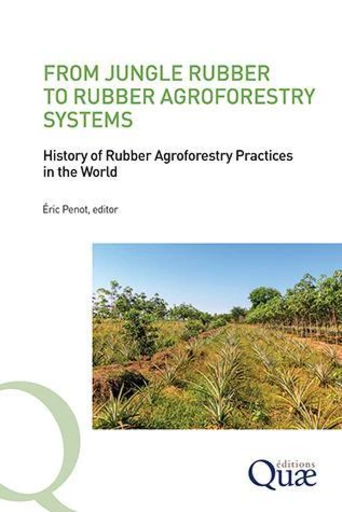
Rubber Agroforestry Systems (RAS) have been developed by local farmers in Southeast Asia initially through the development of jungle rubber. Jungle rubber is a very practical and easy way to develop at very low cost non clonal rubber plantations with forest regrowth, being then the main smallholding rubber cropping system until the 1950s. Later on, for political reasons, clonal plantations with better productivity were developed though national planting programs in Malaysia, Thailand and Indonesia. Today, most of the jungle rubber has disappeared or is not anymore tapped, replaced by monoclonal plantation.
However, in some countries, some local farmers continue to adopt or develop agroforestry practices, basically associating rubber with various number and types of plants and trees in both immature and mature period, in order to increase global productivity at plot level and diversify sources of incomes to increase farms’ resilience.
In this book, we explain what has been the historical and societal conditions for RAS to develop in countries like Thailand and Indonesia and why there is a future for RAS in the current world with global economic uncertainty. The objective is to provide evidence of RAS interest and constraints in order to develop such systems in other countries. The book integrates various sources from the editor and associated researchers and students, written since 1994 and updated in 2024.
Sommaire
Acknowledgments
Foreword
Introduction
Éric Penot, Joseph Adelegan, Lekshmi Nair, Hugo Lehoux, Adrien Perroches, Lucie Poline, Jerôme Sainte-Beuve
Rubber in the world
The concept of agroforestry and agroforestry systems
Chapter 1. Definition and history of RAS
Éric Penot, Bénédicte Chambon, Pascal Montoro, Wilfried Shueller
Rubber in Southeast Asia from 1900 to 2023
The development of clonal rubber-based agroforestry plantations: a new challenge
Chapter 2. Rationale for RAS and impact of agroforestry systems
Éric Penot, Bénédicte Chambon, Gede Wibawa, Karine Trouillard, Elok Mulyoutami, Ilahang, Diah Wulandari, Laxman Joshi, Stephanie Diaz Novellon, Isabelle Michel, Aude Simien, Laetitia Stroesser, Vichot Jongrungrot, Somiot Thungwa, Didier Snoeck, Uraiwan Tongkaemkaew, Marion Theriez, Phillipe Courbet
The need for improved rubber agroforestry systems (RAS)
Main results of RAS
Farmers in West Kalimantan and RAS
Diversification of perennial crops to offset market uncertainties in West Kalimantan
RAS case studies in southern Thailand
Rubber versus other alternatives: what role for RAS?
Changes in RAS patterns in West Kalimantan from 1994 to 2019
Chapter 3. RAS in the rubber world: current agroforestry practices in various countries
Éric Penot, Noé Biatry
Origin and development of RAS
The key impact of shade
The situation in South and South East Asia
The situation in Africa
The situation in South and Central America
Double-spacing systems: an alternative system for full-sun species associated with rubber
Timber species
Conclusion
Chapter 4. Expectations of RAS, impacts and contribution to current’s main challenges in 2024
Éric Penot, Bénédicte Chambon, Alexis Thoumazeau, Phillipe Thaler
Agroforest cropping systems provide miscellaneous goods and services
Impact on soils
Adaptation to climate change
Environmental concerns and externalities
Interest of certification
Rubber and oil palm.
Conclusion
Conclusion and perspectives for the future
Éric Penot, Bénédicte Chambon, Stéphane Boulakia
Markets trigger agroforestry: the importance of understanding how income is generated in agroforestry
Rubber production and sustainability
A new political environment that accounts for environmental concerns
Some innovative systems for the future
The final word
Bibliography
Various sources of information
List of abbreviations
Appendices
List of authors