Présentation
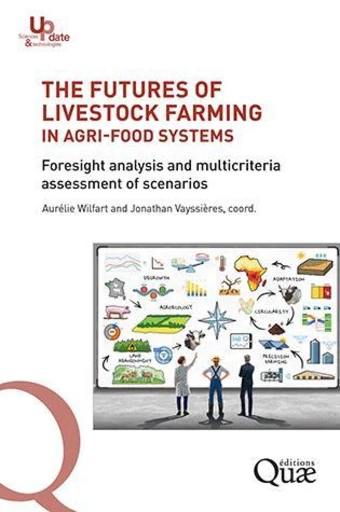
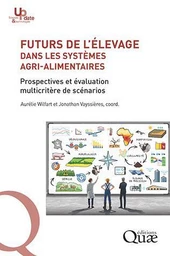
The global food system is facing three major challenges: providing food security, protecting the environment and improving human health. These challenges place livestock farming at a crossroads. However, changes in diets, population growth and changes in the agricultural landscape vary depending on the regions of the world. These dynamics raise questions about the role of livestock farming in territories, the types of farming, its impacts and the services it can provide. How can we anticipate these changes and assess their consequences?
This book presents several different foresight studies that were carried out in different contexts (Global North and Global South) and at different scales (from local to global). It examines the connection between qualitative (joint) scenario building methods and quantitative modelling and assessment approaches. This work also explores the time sequence for the foresight–modelling–assessment cycle, identifying key variables, using data and the role stakeholders play in this whole process, especially when it comes to using these results to make decisions.
This book is based on work arising from the Research School that was organized by INRAE and CIRAD within the framework of the Macro-Livestock-Environment Joint Technology Network (RMT MAELE). The target audience is the scientific community engaged in interdisciplinary approaches. It will also be of interest to anyone working with agriculture, the environment and food, as well as to persons working in the field of sustainable agricultural development.
This Print On Demand book will be sent within 1 to 2 weeks (metropolitan France) and in a separate package if you order another paperback book.
Ce titre est également disponible en français sur notre site : / This book is also available in French on our website : Futurs de l’élevage dans les systèmes agri-alimentaires
Sommaire
Preface
Acknowledgements
General introduction
Aurélie Wilfart, Sandrine Espagnol, Mathieu Vigne, Olivier Mora and Jonathan Vayssières
Part 1. Foresight studies and changes in livestock farming within territories
Chapter 1. Foresight and questions surrounding livestock farming
Olivier Mora and Audrey Béthinger
Introduction to foresight approaches
Role of foresight analysis and scenarios in addressing uncertainty and complexity
The challenge of livestock farming in global foresight scenarios
Diverse ways of approaching the future of livestock farming
Chapter 2. Agriculture in Brittany in 2040: an exploratory foresight study in the region of Brittany
Maud Marguet
The start of the project
Baseline studies prior to constructing a foresight system
Building foresight systems
Conclusion
Chapter 3. Towards peaceful transhumance at the border between Togo and Burkina Faso. A territorial and anticipatory approach
Jean-Michel Sourisseau and Véronique Ancey
Study background and objectives
General approach
Outcomes and lessons learned
Perspectives
Conclusions
Chapter 4. Transition(s) 2050, prospective modelling of the French agricultural and food sectors
Antoine Pierart
Introduction
Methodology
Limitations and outlooks
Coupling “foresight and assessment”
Conclusion
Chapter 5. The importance of livestock farming and animal products in the Agrimonde-Terra foresight project on land use and global food security in 2050
Olivier Mora and Chantal Le Mouël
The Agrimonde-Terra method: combination of a scenario method and digital simulation approach
Land use and global food security scenarios and their quantified impacts
Future challenges of livestock production for food and nutrition security
Limitations of livestock quantification in Agrimonde-Terra scenarios
Conclusion
Part 2. The inclusion of modelling and scenario assessments in foresight approaches
Chapter 6. Introduction to scenario modelling and assessments
Jonathan Vayssières, Mathieu Vigne and Aurélie Wilfart
Why do scenarios from foresight studies need to be modelled and assessed?
An introduction to modelling and assessment approaches
Four studies illustrating the diversity of modelling-assessment methods and their use in foresight studies
Chapter 7. Use of the MAELIA platform to perform an integrated assessment and modelling of agricultural systems and farmlands within a foresight approach
Olivier Therond
From sustainability issues to integrated approaches
Yes, there needs to be integration, but of what?
An integrated modelling approach to territories
MAELIA, an integrated assessment and modelling platform for agricultural systems and farmlands
MAELIA, supporting dynamics in several application areas
MAELIA, streamlining research and supporting agriculture and bioeconomy actors
Specific features of the MAELIA platform
Maelia to support territorial foresight approaches
Chapter 8. Assessing the multifunctionality of livestock grazing systems within territories: examples from the Sahel and South-East Asia
Alexandre Ickowicz, Mélanie Blanchard, Vincent Blanfort, Jean Daniel Cesaro, Christian Corniaux, Arona Diaw, Bernard Hubert, Jacques Lasseur, Huyen Le Thi Thanh, Jean-Pierre Müller, Liz Wedderburn
Introduction
Why apply a multifunctionality concept to livestock grazing systems
Building a multifunctional conceptual model to support the dynamics of local livestock grazing systems
Case studies using a multifunctionality approach to livestock farming in Vietnam and Senegal
Transversal multifunctionality analysis
Conclusion
Chapter 9. Afterres 2050: from creating scenarios to assessing them
Christian Couturier
History and objectives of the Afterres 2050 scenario
Foundations of the approach
Exploring the Afterres 2050 scenario
Targets
Chapter 10. An agroecological Europe in 2050, “Ten Years For Agroecology” (TYFA) scenario
Pierre-Marie Aubert and Xavier Poux
Introduction
TYFA scenario assumptions
Results
Discussion
Conclusion: reviewing the role of permanent grasslands and ruminants in the sustainability agenda
Part 3. Transversal analysis of foresight exercises and scenario modelling-assessment
Chapter 11. Analysis frameworks for coupling approaches to better combine foresight and assessment
Mathieu Vigne and Jonathan Vayssières
Why use a framework to help choose the type of coupling?
Assessments play various roles in the coupling process
The choice of coupling type is based on data availability
From an analysis framework to a typology for coupling frameworks
Conclusion and outlook
Chapter 12. Components of agri-food systems and variables in foresight scenarios
Aurélie Wilfart, Olivier Mora and Sandrine Espagnol
Assumptions and background data for foresight scenarios
Foresight scenario assessment methods
Chapter 13. Possible futures for livestock farming and ownership by policy makers
Aurélie Wilfart, Olivier Mora and Sandrine Espagnol
Introduction: the role of foresight studies in the public policy cycle
Livestock farming at the centre of numerous French government departments
The main political actions concerning livestock farming in France
How are foresight studies used in French public policy?
What about in other contexts elsewhere in the world?
General conclusion. Key points to remember
Jonathan Vayssières and Aurélie Wilfart
Thematic summary
Methodological summary
Functional summary
Bibliographic references
Abbreviations and units
List of authors