Présentation
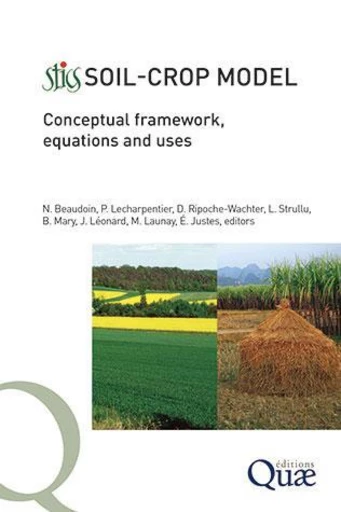
The STICS crop model has been developed since 1996 at INRA (French National Institute for Agronomic Research) in collaboration with other research and technical institutes. The model syntheses, illustrates and concretizes an important part of the French agronomic knowledge as a point of view on the field and cropping systems working. The formalisations of the STICS crop model presented in this book can be considered as references used in the framework of crop sciences. They will help professionals and students in the partitioning and understanding of the complex agronomic system. The book arrangement relies on the way the model designs the crop-soil system functioning, each chapter being devoted to a set of important functions such as growth initiation, yield onset, water uptake, transformation of organic matter etc. One chapter deals with the cropping system and long term simulations and the final chapter is about the involvement of the user in terms of option choices and parameterization.
If this book is mainly intended for scientists who use the STICS model, it can also be useful for agronomists, crop modellers, students and technicians looking for elementary formalizations of the crop-soil system functioning.
Projet financé avec le soutien du Fonds National pour la Science Ouverte.
Sommaire
Foreword
Peter Thorburn
Dedication
Preface
Nicolas Beaudoin, Patrice Lecharpentier and Dominique Ripoche-Wachter
The first book
A new book based on an innovative approach
Project funding
English revision
Chapter 1. Introduction
Dominique Ripoche-Wachter, Nicolas Beaudoin and Eric Justes
1.1 History
1.2 Purpose
1.3 The STICS open book
1.4 Human-machine interfaces
1.5 Tools for STICS users
Chapter 2. Overall description of the modelled system
Nicolas Beaudoin, Dominique Ripoche-Wachter, Marie Launay, Eric Justes and Nadine Brisson
2.1 Conceptual framework
2.2 STICS validity domain
2.3 Relationship and priority between processes
2.4 Model genericity
2.5 Parameterised crop species
Chapter 3. Development
Nadine Brisson, Iñaki García de Cortázar Atauri, Marie Launay and Dominique Ripoche-Wachter
3.1 The importance of phenology on crop development
3.2 Simulated events
3.3 Main development processes
3.4 Emergence and initiation of crop development and growth
Chapter 4. Shoot growth
Loïc Strullu, Alain Mollier, Jean-Louis Durand and Nadine Brisson
4.1 Leaf dynamics
4.2 Radiation interception
4.3 Biomass production
4.4 Stress indices
Chapter 5. Root growth
Nadine Brisson, Nicolas Beaudoin, Alain Mollier, Florent Chlebowski, Marie Launay and Loïc Strullu
5.1 Introduction
5.2 Vertical root growth
5.3 Root length density production and root distribution
5.4 Turnover of root biomass and N content allocation
5.5 Calculation of root density for water and nitrogen absorption
Chapter 6. Nitrogen acquisition by plants
Bruno Mary, Fabien Ferchaud, Loïc Strullu and Nadine Brisson
6.1 Nitrogen uptake by plants
6.2 Nitrogen fixation by legumes
Chapter 7. Biomass and nitrogen partitioning
Loïc Strullu, Jean-Louis Durand, Bruno Mary, Nicolas Beaudoin and Nadine Brisson
7.1 Introduction
7.2 Identified organs and compartments
7.3 Vegetative organs
7.4 Remobilisation of reserves
7.5 Harvested organs
7.6 Roots
7.7 Biomass and nitrogen partitioning after cut of forages
7.8 N and C inputs to the soil from perennial crops
Chapter 8. Yield formation
Nadine Brisson, Iñaki García de Cortázar Atauri, Françoise Ruget and Benjamin Dumont
8.1 Quantitative yield
8.2 Yield quality
Chapter 9. Canopy microclimate
Nadine Brisson, Marie Launay and Gaetan Louarn
9.1 Introduction
9.2 Radiation interception
9.3 Energy budget and crop temperature
9.4 Canopy moisture
9.5 Climate under shelter
9.6 Correcting temperatures for high altitude climates
Chapter 10. Transfers in soil: water, nitrate and heat fluxes
Joël Léonard, Bruno Mary, Guillaume Jego, Nicolas Beaudoin and Nadine Brisson
10.1 Water and nitrate fluxes
10.2 Soil temperature
10.3 Modifications of surface conditions that influence water and heat transfer
Chapter 11. Water balance
Nadine Brisson, Remi Vezy, Dominique Ripoche-Wachter and Patrick Bertuzzi
11.1 Background and conceptual framework
11.2 Soil evaporation
11.3 Potential crop water requirements
11.4 Physical soil surface conditions
11.5 Plant transpiration and derived stresses
11.6 Water balance
Chapter 12. Carbon and nitrogen transformations in soil and balances
Bruno Mary, Fabien Ferchaud, Hugues Clivot and Joël Léonard
12.1 Organic and mineral C-N pools
12.2 Decomposition and mineralisation of organic matter
12.3 Nitrification
12.4 Denitrification
12.5 N2O emissions
12.6 Ammonia volatilisation
12.7 Carbon and nitrogen balances
Chapter 13. Soil-crop management effects
Nadine Brisson, Bruno Mary and Dominique Ripoche-Wachter
13.1 Introduction
13.2 Crop management
13.3 Crop operations and soil tillage
13.4 Soil water management
13.5 Nitrogen and carbon inputs in soil
Chapter 14. Ways of STICS use
Nicolas Beaudoin, Julie Constantin, Anne-Isabelle Graux, Gatien Falconnier, François Affholder,
Françoise Ruget and Laurent Ruiz
14.1 Defining the unit of simulation (USM)
14.2 Rotations and long-term simulations
14.3 Simulation over large spatial scales
14.4 Simulation with coupled models
14.5 Typology of STICS uses
14.6 Perspectives for model capacity extension toward agroecology
Chapter 15. Tools for smart use of the standard STICS model version
Dominique Ripoche, Christine Le Bas and Nadine Brisson
15.1 Driving use options
15.2 Strategy use options
15.3 Model formalism options
15.4 Parameterisation
15.5 Tools for users
Chapter 16. Model capacity extension methods
Samuel Buis, Guillaume Jego and Eric Casellas
16.1 Introduction
16.2 Evaluating model performances
16.3 Adapting STICS to a new crop or cultivar
16.4 Tools and rules for model coupling
References
Chapter 17. Definition of symbols
17.1 Definition of parameters
17.2 Definition of output variables
17.3 Internal variables definition
Authors list