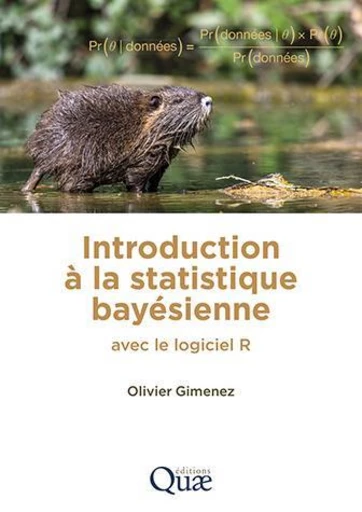
La statistique bayésienne est partout : prévisions météo, analyses d’épidémies, préservation de la biodiversité… Dans un monde incertain, elle permet d’estimer, de prédire et de décider, en donnant un sens aux données.
Ce livre propose une introduction accessible et concrète à la statistique bayésienne.
L’auteur explique pas-à-pas les fondements de l’approche, sa singularité et la logique qui sous-tend le raisonnement bayésien. L’apprentissage s’appuie sur le logiciel libre R et se construit à partir de questions de recherche liées à l’écologie du ragondin qui constitue le fil rouge de l’ouvrage.
Chaque chapitre aborde un pilier essentiel : le théorème de Bayes, les méthodes de Monte Carlo par chaînes de Markov (MCMC), le choix et le rôle des distributions a priori, la régression linéaire et ses extensions, les modèles linéaires généralisés (mixtes ou pas), jusqu’à la comparaison et la validation de modèles. Le lecteur est invité à coder, simuler, tester et visualiser pour comprendre, grâce aux exemples et au matériel en ligne.
Rédigé dans un style direct et didactique, comme un échange entre enseignant et étudiant, l’ouvrage démystifie la statistique bayésienne. Il s’adresse à tous ceux qui souhaitent se former à cette approche : étudiants, universitaires… et toute personne souhaitant appliquer ces méthodes en sciences du vivant, des données ou de l’environnement.