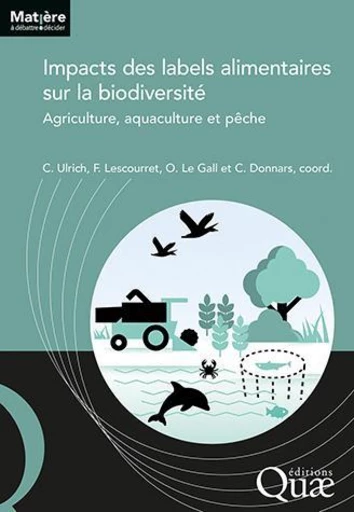
La loi Climat et résilience de 2021 propose la mise en place d'un affichage environnemental sur les produits alimentaires afin d'informer les consommateurs de l'impact de leurs achats sur les écosystèmes. Parmi ces impacts, ceux sur la biodiversité sont toutefois difficiles à appréhender de manière synthétique. Cet ouvrage documente ce volet biodiversité, en se focalisant sur les pratiques de production d'un échantillon de labels alimentaires couvrant des produits issus de l'agriculture, de l'aquaculture et de la pêche.
Il reprend les principaux enseignements d'une étude réalisée par un comité scientifique pluridisciplinaire à la demande des ministères en charge de la transition écologique, de l'agriculture et de l'alimentation ainsi que l'Ademe. L'échantillon étudié illustre la diversité des labels : publics ou privés, nationaux ou internationaux, transversaux (l'agriculture biologique, par exemple) ou spécialisés dans une filière (soja, poisson, etc.).
La littérature scientifique liant labels et impacts sur la biodiversité sauvage ne concernant que peu de cas de figures, les auteurs proposent une démarche qui passe par l'analyse des pratiques identifiées dans les cahiers des charges. Et au-delà, ils s'intéressent au design institutionnel des labels (référentiel, contrôle, accréditation, traçabilité) ainsi qu'au contexte réglementaire et socioéconomique qui contribuent à garantir l'effectivité de leurs engagements.
Enfin, trois pistes méthodologiques sont explorées pour quantifier les impacts sur la biodiversité, en vue d'une application dans l'affichage environnemental.
Cette analyse s'adresse aux décideurs et aux collectivités territoriales, aux professionnels des milieux agricoles, aquacoles et marins ainsi qu'à toute personne intéressée par les systèmes alimentaires et leurs impacts sur l'environnement.