Présentation
This Print On Demand book will be sent within 3 weeks (metropolitan France) and in a separate package if you order another paperback book.
Cet ouvrage en impression à la demande sera envoyé sous 3 semaines environ (France métropolitaine) et dans un colis séparé en cas de commande avec un autre livre papier.
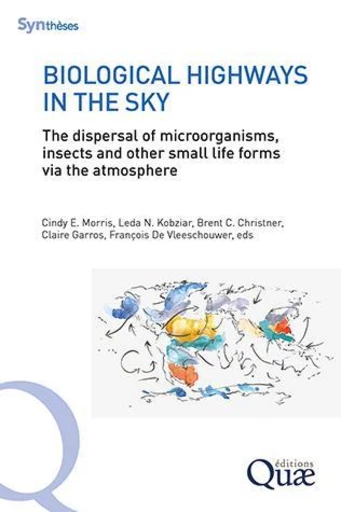
This book explores the atmosphere as a dynamic transport system for small biological particles in the atmosphere, with a focus on microorganisms and small insects, applicable to nematodes, spiders, tardigrades, etc. It brings together interdisciplinary competence from Life, Earth and Mathematical Sciences to describe emissions processes such as wildfire smoke, sea spray and recurrent uplift from plant canopies; transport processes and trajectories in the past, present and future; and how the voyagers survive the atmospheric physico-chemical conditions. The book introduces tools to trace dispersal routes, assess post-deposition impacts, as well as the concepts of “atmospheric biogeography” and “windsheds” to understand and anticipate microbial movement across landscapes and borders. It offers stimulus to both new and established researchers to undertake an important challenge in aerobiology: to more precisely characterize and quantify the dynamics of particle voyages on the highways of the atmosphere and identify the impacts of these voyages on disease epidemiology, environmental quality and the evolution of organisms.
Sommaire
Introduction: the precarious yet never-ending cycle of voyages on high
Cindy E. Morris, Leda N. Kobziar, Brent C. Christner, Claire Garros, François De Vleeschouwer
Section 1. The nature of atmospheric highways and principles for understanding how microbial particles can ride them
Chapter 1. Air mass movement across Earth: Highways for particle transport in the past, present and future
Fabrice Lambert
Chapter 2. A primer on the aerodynamic traits of microbial particles that define their capacity for dispersal
Cindy E. Morris
Chapter 3. Approaches to quantifying emissions of bioaerosols and hunting for the hot spots
Federico Carotenuto
Chapter 4. Modelling the transport of microorganisms: What can we learn from particle transport models?
Rémy Lapere, Sylvain Mailler
Section 2. The travel diaries of microorganisms and insects that ride the winds
Chapter 5. Uncovering microbial resilience aloft: Exploring boundary conditions in atmospheric environments
Kevin P. Dillon, Donna E. Fennell, Gediminas Mainelis
Chapter 6. Metabolic activity of airborne microorganisms
Florent Rossi, Raphaëlle Péguilhan, Pierre Amato
Chapter 7. Release of primary biological aerosol particles from surface waters
Paul Zieger, Julika Zinke, Gabriel Pereira Freitas, Matthew Salter
Chapter 8. Wildland fire smoke plumes as generators and transporters of living bioaerosols
Leda N. Kobziar, Krista Bonfantine, James Markwiese, Jay R. Reichman, Taylor Minich, Timothy Dean, Phinehas Lampman, Kalia Bistolas
Chapter 9. More than wings: Long-distance dissemination of insects in the atmosphere
Margaux Darnis, Alexandra Schoeny, Nicolas Sauvion
Chapter 10. Glacial archives of ancient atmospheres and aerobiota
Fiona Harris, Brent Christner
Section 3. The extent of aerial voyages and their impact on disease epidemiology and environmental quality
Chapter 11. An overview of the demographic and genetic toolbox for assessing wind-assisted dispersal
Margaux Darnis, Karine Berthier
Chapter 12. Ecosystem invasion by airborne microorganisms
Marie Labat Saint Vincent, Romie Tignat-Perrier, Aurélien Dommergue, Catherine Larose
Chapter 13. Biology of the air we breathe: Potential impact on health
David Sykes, Elisa Giammarini, Gillian Clayton, Iain McLellan, Andrew Hursthouse
Chapter 14. Using the logic of aerial dissemination patterns and networks for optimizing plant disease surveillance strategies
Andrea Radici, Davide Martinetti
General Conclusion
Cindy E. Morris, Leda N. Kobziar, Brent C. Christner, Claire Garros, François De Vleeschouwer