Summary
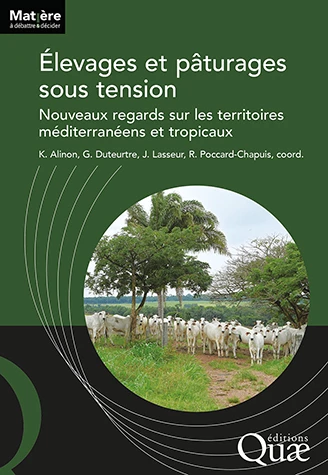
Hundreds of millions of people worldwide rely on pastoralism for their livelihoods. It can serve as a source of inspiration to rethink and support other forms of agriculture, agrarian change, and our perception of "nature."
This book revisits current issues (agroecology, shared land access, reproduction of livelihoods, heritage creation, socio-ecological systems, sustainability, territorial governance, animal health, climate change, etc.) through the lens of pastoralism.
It proposes a renewal of our conceptual frameworks in the face of Anthropocene challenges by reconsidering our ways of doing (techniques), our ways of making intelligible (sciences), and ultimately, our ways of governing (politics).
Table of contents
Acknowledgements
Preface by Bernard Hubert
Introduction
Chapter 1: How pastoralism helps rethink agroecology
Magali Jouven, Mélanie Blanchard, Sib Ollo, Fabien Stark, Serena Ferrari, Paulo Salgado, Mathieu Vigne, David Berre, Éric Vall
Introduction
Pastoralism: characteristics of an ubiquitous livestock production system
Pastoral practices ensuring autonomy, resilience, and inclusion
Pastoral dynamics and agroecological transition
Conclusion
Bibliography
Chapter 2: Engaging "off-field": From pastoral land tenure to extensive zebu farming in Madagascar
Perrine Burnod, Oginot Manasoa, Holy Raharinjanahary, Véronique Ancey
Introduction
Starting point: land tenure issues in pastoral spaces
A thematic investment based on field data collection
A thematic investment combined with an analytical investment
From a thematic investment to a political investment
Conclusion
Bibliography
Chapter 3: Pastoralism in its territories: Governance and strategic complementarities
Irène Carpentier, Jean-Michel Sourisseau, Jean-Daniel Cesaro
Rethinking pastoral territories through their connections
A territorial approach to pastoralism in Tunisia
Pastoralism as an object of representation
A territorial anchoring difficult to grasp: fragmentation and multiplicity of forms
Pastoralism: a world of territorial fluidity
Conclusion
Bibliography
Chapter 4: Balkan pastoralisms: Heritagizing the origin in the face of decline?
Claire Bernard-Mongin
Introduction
Between territorial reconfigurations and the decline of livestock farming
Heritagization through geographical indications: promises and tensions
Balkan GIs: the emergence of a heritagization infrastructure
Pastoral geographical indications: tracking the trail
Topography of waypoints: negotiated architecture of specifications
Mapping the entrepreneurs of Balkan pastoralisms
Compromise and redefinition of pastoralism in a heritagization process
Blind spots in the heritagization of pastoralism through Gis
Conclusion
Bibliography
Chapter 5: Health on the move: Health risk management in the pastoral world
Marion Bordier, Andrea Apolloni, Alexis Delabouglise, Raphaël Duboz, Pachka Hammami, Séverine Thys
Introduction
Animal health and its management in the context of pastoralism
Improving animal health in the context of pastoralism
Conclusion
Bibliography
Chapter 6: Social reproduction of pastoralism as an institutional compromise
Pierre Girard, Sara Mercandalli, Sergio Dario Magnani, Charline Rangé, Véronique Ancey
Introduction
Rural transformations in Sub-Saharan Africa and regulation theory
Pastoralism and social change in the Sahel through the lens of the activity social relation
Contextualizing pastoralism within state trajectories
Bibliography
Chapter 7: African pastoral territories: Systems rich in biocultural diversity
Alexandre Caron, Mohamed Habibou Assouma, Simon Taugourdeau, Saverio Krätli
Pastoral savannas as socio-ecological systems
The architect of biocultural wealth and ecological functionality of rangelands
Global changes disrupting systems based on variability
Trajectories of SESs: commodification, transformation, and denaturation
Opportunities for reorienting SESs
Toward a relational reading of SES "health"
Bibliography
Chapter 8: Rethinking the links between sustainability and governance: Pastoralism in the Sahel
Véronique Ancey, Sergio Dario Magnani
Introduction
Functional integrity: rethinking sustainability with governance
Understanding functional integrity and how it can be destroyed
Conclusion
Bibliography
Chapter 9: Pastoralism and climate change: Vulnerability, contribution, and solutions
Vincent Blanfort, Serena Ferrari, Maé Julien, Anouk Bassou, Véronique Alary
Introduction
Global challenges and methodological approach
A narrative-based approach
From stakeholder narratives to contemporary issues taken up by the media
Pastoralism in the IPCC, climate COPs, and global climate diplomacy
Cross-analysis of pastoral narratives: who influences whom?
Bibliography
Conclusion
Three constitutive dimensions of pastoralism
Transforming our way of seeing the world
Bibliography
List of authors